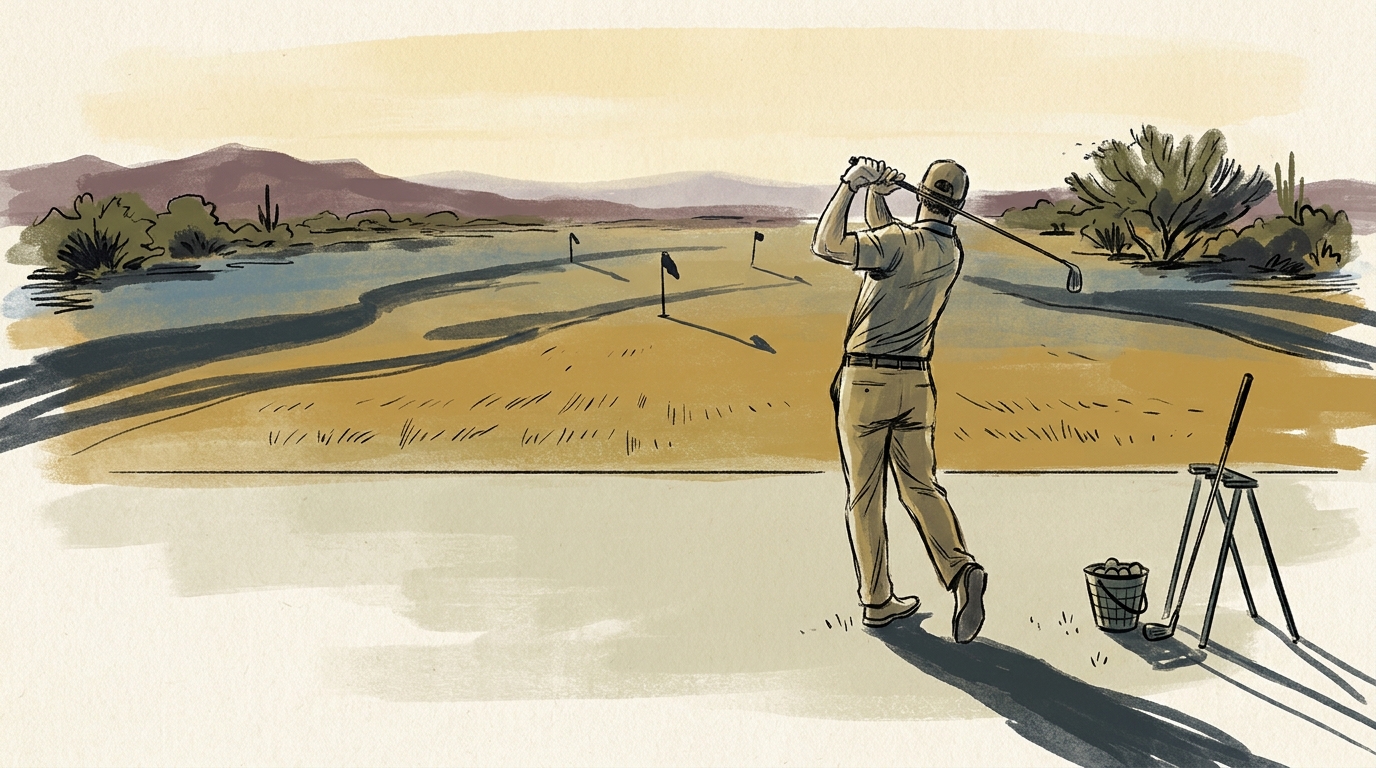
A warm-up transfers to the course when you treat it as rehearsal, not repair. Spend about five minutes getting your body loose with light calisthenics, then start with 20–30 yard wedge shots and work up through the bag, finishing with a handful of realistic tee-shot rehearsals using your full pre-shot routine. Beating balls at the same target with the same club is what breaks the transfer.
Most Mesa, AZ golfers show up 15 minutes before their tee time, hit a half bucket of drivers, and wonder why the swing that was flushing on the range disappears by the second hole. The fix is less about swing thoughts and more about structure — and in a desert climate where you might be teeing off at 6 a.m. in July or 1 p.m. in January, how you warm up matters more than most players admit.
How early should you arrive at the course to warm up properly?
Plan to arrive about 60 minutes before your tee time. That's the window used by coach Mark Blackburn's one-hour range framework and the same arrival requirement enforced at courses like Sunken Meadow State Park in New York, which asks golfers to be on-site one hour before their scheduled tee time. An hour gives you time to check in, loosen up, hit progressively, and still get to the putting green.
In Mesa, that hour does double duty. Summer mornings mean you're warming up in the dark-to-dawn transition; winter mid-mornings mean the desert air is still cool enough that your lower back needs real activation before it sees a driver. Dobson Ranch Golf Course is open from 5 AM to 9 PM Monday through Sunday, so the arrival window is wide — but the one-hour cushion is the one that actually works.
What should the first five minutes of your warm-up look like?
Spend the first five minutes doing calisthenics — jumping jacks, lunges, air squats — before you ever pick up a club. That's the recommendation from coach Mark Blackburn, who notes the golf swing is a dynamic, explosive movement that generates and requires the body to absorb a lot of force.
Blackburn is explicit: don't use the club to warm up the body. The body should already be warm before you pick one up. In Mesa's summer heat this is easier; in a cold January early-morning tee time, it's non-negotiable if you want your first tee ball to look like your range ball.
How should you progress through the bag on the range?
Start with 20–30 yard shots using a lob wedge, then progressively work up through the wedges to a pitching wedge during minutes 5–15. This is the Blackburn progression, and it does two things: it grooves tempo at a scale where mishits don't scare you, and it lets your rotation open up gradually before you ask your body for driver speed.
From there, minutes 15–30 are drill work with a medium to shorter iron — choose three or four drills and rep them, not 15. The goal is grooving one or two beneficial movement patterns, not auditioning swing theories 20 minutes before you tee off.
A one-hour range session breakdown
| Minutes | Focus | Clubs |
|---|---|---|
| 0–5 | Body warm-up (calisthenics) | None |
| 5–15 | Starting to swing, 20–30 yard shots up through wedges | Lob wedge → pitching wedge |
| 15–30 | Drill work, 3–4 drills | Medium to shorter iron |
| 30–45 | Performance practice, varied targets | Full bag, rotating |
| 45–60 | Short game | Wedges and putter |
What is 'performance practice' and why does it transfer?
Performance practice is the 15-minute block (minutes 30–45) where you stop hitting the same shot to the same target. Blackburn's point is simple: on the course you never hit ball after ball with the same club to the same flag, so a warm-up full of that kind of rep doesn't transfer. Change clubs every shot. Change targets. Run your full pre-shot routine. That's what rehearses the course.
Practically: alternate a mid-iron to the left flag, hybrid to the center, wedge to the near flag, driver down a defined fairway corridor. One ball, one routine, one target, then switch. This is the single highest-leverage change most range sessions are missing.
Where does the short game fit in a pre-round warm-up?
Minutes 45–60 go to short game. If the facility has a chipping green and a putting green, use both — a few greenside chips to feel contact and spin, then a putting routine that covers lag speed from 30–40 feet and short putts inside eight feet. Even the best players in the world make roughly 50% of putts inside about eight feet, which means the short putt you lip out on the second hole was statistically likely, not a swing flaw.
Dobson Ranch Golf Course has a putting course called The Stable where kids play free every day, which doubles as a legitimate speed-and-read warm-up for the parent. Walk-in access to the driving range is available with no reservation required, which matters when your tee time slides earlier than planned.
What should Mesa, AZ golfers factor in that other markets don't?
Three things: heat, dryness, and tee-time compression. In summer, courses push tee times earlier to beat the desert afternoon, which means your warm-up is happening at sunrise when your body is coldest — the calisthenics step is doubly important. The dry desert air also means hydration starts during the warm-up, not on the fifth hole.
Dobson Ranch Golf Course sits at 2155 South Dobson Road in Mesa, with an 18-hole championship course that plays Par 72 at 6,712 yards with tree-lined fairways — not the wide-open desert layout many visitors expect, which rewards a warm-up that includes shaped iron shots, not just straight-ball bombs.
What does a Mesa, AZ practice facility bring to the routine?
A good local range lets you execute all five phases without friction. Dobson Ranch Golf Course operates Smashers On Driving Range, which features Inrange-powered bays with practice and games for all levels, and food and drinks delivered to bays. The tech matters because launch feedback during performance practice tells you whether that mid-iron actually carried the number you thought it did.
On-site golf instruction is also available if your warm-up keeps revealing the same miss and you've decided it's time to fix it instead of just managing it. And the no-stuffy-dress-code posture is worth noting if you're squeezing in a warm-up on a lunch break.
"We love it here at DR! Range is super fun with in-range, good tables, and great servers- Mark and Zoe always take great care of us! Benji in the shop is always friendly too." — 5★ · Natalie, Aug 2026
Frequently asked questions about pre-round range warm-ups
How long before my tee time should I get to the course?
Arrive about 60 minutes before your scheduled tee time. That gives you five minutes for a body warm-up, roughly 40 minutes on the range progressing from wedges through drills and performance practice, and 15 minutes for short game and putting. It also leaves cushion for check-in, the cart, and getting to the first tee without rushing — rushing is what undoes the warm-up you just did.
Can I skip the calisthenics and just swing a wedge to warm up?
No. Coach Mark Blackburn is explicit that the body should already be warm before you pick up a club, because the golf swing is a dynamic, explosive movement that generates and requires the body to absorb a lot of force. Five minutes of jumping jacks, lunges, or air squats activates the muscles that protect your lower back and shoulders — swinging a cold club into those positions is how most range-session injuries happen.
Why should I start with 20–30 yard wedge shots instead of mid-irons?
Short wedge shots let you build tempo and feel contact at a scale where mishits don't rattle your confidence or your body. Starting at 20–30 yards with a lob wedge and progressively working up through the wedges to a pitching wedge grooves rhythm before you ask the body for full rotational speed. Jumping straight to a mid-iron or driver skips the ramp and usually produces the mishits you're trying to avoid.
How many drills should I actually work on before a round?
Three or four drills, with a medium to shorter iron, during minutes 15–30 of the warm-up. The goal is grooving one or two beneficial movement patterns, not re-engineering your swing 30 minutes before you tee off. Pre-round is maintenance, not construction — if a drill reveals a bigger issue, note it for a dedicated practice session later rather than trying to solve it on the first tee.
What's the biggest mistake golfers make in their range warm-up?
Hitting the same club to the same target over and over. On the course you never do that — every shot is a different club, a different target, a different lie. A warm-up full of repetitive reps doesn't rehearse the game you're about to play. The fix is performance practice: alternate clubs and targets, run your full pre-shot routine on every ball, and treat the last 15 minutes of range time as a dress rehearsal.
Where can I warm up in Mesa, AZ before an early tee time?
Dobson Ranch Golf Course at 2155 South Dobson Road offers walk-in driving range access with no reservation required, with hours running 5 AM to 9 PM Monday through Sunday. The on-site Smashers On Driving Range uses Inrange-powered bays, so you get shot data during performance practice, and the putting course called The Stable gives you a place to dial in green speed before heading to the first tee.
Putting it together
The warm-up that transfers isn't longer or more technical — it's structured. Five minutes to warm the body, ten minutes of short wedges, fifteen minutes of focused drill work, fifteen minutes of varied performance practice, and fifteen minutes of short game. Show up 60 minutes before your tee time and that whole sequence fits with room to spare.
Golfers in Mesa, AZ who want to run this routine on a range built for it — walk-in access, Inrange-powered bays, a dedicated putting course, and on-site instruction if the warm-up keeps surfacing the same miss — can reach Dobson Ranch Golf Course at (480) 644-2291 or visit https://www.dobsonranchgolfclub.com/ to plan a session before their next round.